 I’ve been itching to get my hands on an Mi4 for some time now, and after building and running the car for the first time, I have to say it was worth the wait.
That said, lets start from the beginning and not get too far ahead of ourselves. And a word of warning…freed from the word limits of print publications….this is a long story, with plenty of detail from our test weekend at the 2009 Northern Rivers Championship. Read on…and enjoy.
Design & Heritage
The Mi4 is the latest in a line of EP touring cars from Schumacher that stretch back over ten years and represents the application of all they’ve learnt during that period. It builds in particular on the strengths of the Mi3.5, and the CAT SX off-road buggy. As is typical with Schumacher, the Mi4 is an engineers car – with creative design and engineering solutions abounding.
At first glance, it’s an EP touring chassis like most of the others – twin belt transmission with ball diff at the back and spool up front, double-deck carbon fibre chassis, moulded composite suspension components and alloy transmission housings.
Dig a little deeper, and there are some unique design features. The static layshaft (layshaft is fixed, spur and pulleys rotate on it) is improved over the Mi3/Mi3.5 version of the same. Small carbon fibre link mounts connect the motor mount with rear transmission housing – and optional parts in different thickness allow the driver to fine-tune rear-end chassis flex.
The motor mount in itself is drawn from the CAT SX and unlike anything else in the EP touring category. The motor is locked into a wide alloy ring, with the whole unit sliding fore-and-aft to set gear mesh. In practice it has been bullet proof, and the design allows the driver to move the motor laterally to weight-balance the car (even to the extreme of allowing the whole drive-train to be ‘flipped’ to help move even more of the weight to the centre of the chassis.
Elsewhere the transmission is carried over from the Mi3/Mi3.5 range – Schumacher’s excellent ball diff complemented by the heavy duty front spool – solid outdrives having improved the life-span of the drive-shaft blades.
Suspension follows accepted norms, with the usual range of adjustments. The suspension arms themselves are a nice improvement over the previous chassis – with some extra moulding and bracing adding strength. The Mi4 ships with medium flex suspension arms and 4 degree castor blocks. Suspension arm mounts are simpler fixed (moulded composite) items which replace the two-piece alloy mounts of the Mi3/3.5 (still available as optional parts for those who want to play with fine-tuning roll centre). Anti-roll bar mounts change for the first time in years and provide a more positive sway-bar mounting, and more effective action.
Shocks are simple to build, simple to set consistently from shock to shock, and basically a pleasure to work with. I liked them. In terms of springs, the kit I built shipped with Schumacher’s blue front, and white rear springs. In many instances these might be too soft – and having green and blue springs on hand might well be worthwhile.
Steering is of a centre-point, single pivot design, with quick and easy adjustment for Ackermann effect to assist in tuning. Proving that with the Mi4 they have paid attention to small details, Schumacher have retired their venerable (and sloppy) ball-joint design for new, much tighter, ball joints. It makes the whole suspension and steering system much tighter and more direct.
The chassis, with its milled cutouts for bulkheads and motor is a work of art. It’s designed for 5-cell NiMh (still common in Europe at least until later in 2009) or LiPo – with cutouts for most LiPo types. Batteries by default are secured with tape, or the optional Mi4 LiPo tray.
Build
Schumacher have come a long way in terms of part fit and finish. The Mi4 builds well, with everything fitting and functioning as it should. I did choose to run a 3mm reamer through the suspension arm mounts, and had to clear away just a little excess moulding tabs from a couple of the composite pieces.
It’s a build that measures up well against anything else on the market. This is, without question, a top level competition kit – and it shows in the component material, quality, fit and finish.
Construction starts with transmission and major chassis components, before moving on to suspension and then ‘finishings’. Helpfully, Schumacher package the Mi4 with every item needed for each individual construction step in a separate package. It’s an easy way to build a kit – with no hunting for parts and components required at any stage during the build.
As with any full-house race chassis, it’s a case of BYO as far as electronics package is concerned. Bodyshell, wheels and tyres are also to be provided to suit the driver’s particular tastes, and locally suited items.
For our build, we brought the following components to the mix:
- bodyshell: Protoform’s LTC-R
- ESC: LRP Sphere TC Spec
- Steering servo: Futaba S9402
- Motor: Speedpassion Comp 2 4.0turn brushless motor
- Wheels/tyres: Sorex 36r/Sorex C Medium insert on Schumacher revlite rims (pre-mounts)
- Battery: IB5000mah/40c LiPo
- Tx/Rx: Spectrum DX3s / Spectrum receiver
Tuning Options
Schumacher of course offer a full range of tuning options to complement the Mi4. There are the usual items such as spring tuning kits, optional sway bar range, camber-link mounts, suspension mounts and more.
But there are also some interesting new items emerging from the British manufacturer. Front castor blocks in a range of ‘flex’ ratings offer tuning options for steering, while slightly shorter suspension arms are offered, also in different stiffness/material to suit the driver’s needs.
During our testing process, we added the carbon-impregnated short suspension arms, and mid-flex 4 degree castor blocks to see what sort of impact these items have on performance. We also used Schumacher’s optional spring tuning kit, and some HPI springs to further explore setup options.
We also added the optional LiPo tray to the Mi4 – the design making it simple to run LiPo batteries without having to wrestle with tape, and in a manner that avoids tweaking the chassis or inhibiting chassis flex. I love the LiPo tray and will gladly consign my battery tape to the far reaches of my workshop.
Drive Time
I built the Mi4 following the supplied setup for the “Cotswolds” track in the UK (provided with the Mi4 instruction manual) but with the blue front, and white rear springs as provided with my kit.
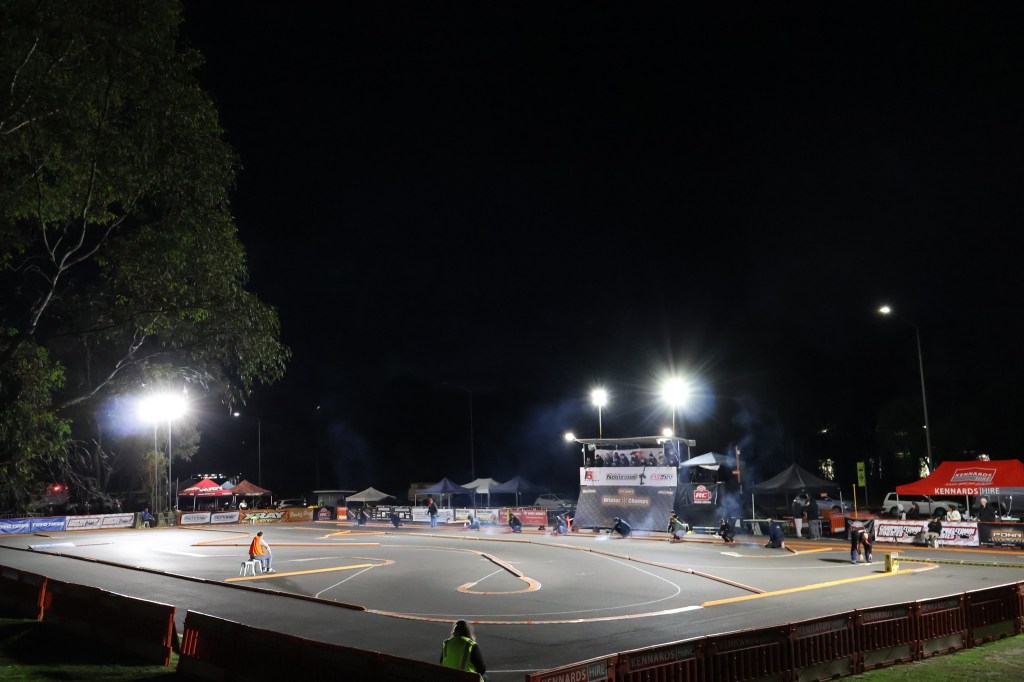
Our test venue was the excellent Gold Coast track – a piece of smooth, fast race track the features some very testing high speed corners, challenging chicanes and a truly memorable high speed turn one leading to a massive braking area for a very slow hairpin. It was the perfect place to explore the Mi4’s potential. Track conditions began dirty and dusty before improving to offer a moderate level of grip throughout the test weekend.
First runs demonstrated the Mi4’s inherent strengths – stability, grip and balance. The chassis proved easy to drive – even with the aggressive LTC-R bodyshell and slippery conditions. Turn-in was good, on-power steering excellent in the spool equipped chassis.
The supplied springs seemed just a little on the soft side as grip slowly improved at our test track – so we first moved up one spring rate all round – to green front, and blue rear springs.
The balance of the chassis was unchanged, but as we hoped, the firmer springs provided a little more positive response and managed chassis roll just a little better.
For the next run, we added green springs to the rear as well – and found a small, but useful improvement in performance with slightly better rotation of the car in slow corners, but still excellent power-down traction.
An experiment with wheel-base (and therefore weight distribution) didn’t bring any useful improvements for me, so for the last run on our practice day, we added the short suspension arms – choosing the stiff carbon impregnated option. To keep track width the same, an extra 1mm shim is added inside the suspension arm mounts.
The arms were a very useful addition to the Mi4 – boosting mid corner speed in the critically important Gold Coast chicane section in front of the driver’s stand. Overall balance was unchanged, and the car remained a pleasure to drive.
As qualifying began I had a few nervous minutes – getting used to racing modified tourers after 18 months away from the class. Once in the groove however, the Mi4 continued to deliver.
We made two significant changes during qualifying – first adding the mid-flex 4 degree castor blocks, and later a set of HPI silver springs (front and rear).
The castor blocks provided just a little stronger performance through the high speed sections – and with the Gold Coast track having four or five reasonably high speed corners, any improvement in this area was very helpful.
HPI springs are a known tuning option across many manufacturer’s chassis due to their consistency, quality and linear performance. For me, on this day, I didn’t find a increase in performance as much as I found a car just slightly easier to drive – and therefore able to be drive more consistently. I liked the HPI springs, and when time allows, will also test the Pink and Gold options (both firmer than Silver). I would also very happily run with the Schuie springs and be comfortable with their performance.
By this stage, I have to say I was thoroughly impressed with the Mi4 and its inherent performance capability. For finals day we rebuild the diff (it had cried enough after about 14 runs in practice and qualifying), replaced a set of drive-shaft blades on the front axles and got set to go racing.
My first A final didn’t start well, two incidents early culminating in a body tuck, and leaving me a long way last. To my delight, when I finally got going, I discovered that the car, on fresh rubber, was an absolute jet. Apart from one self-inflicted error caused by clipping a curb and consequently tumbling across the track, the rest of the run was flawless. The car was excellent to drive – stable under heavy braking, crisp turn-in, excellent mid corner speed, and strong in the high speed sections of the track. I managed to claw my way back to fourth and was coming home with a rush when time ran out.
A2 was better – a cleaner start leaving me as part of intense five-way battle at the front of the field. Eventually things settled down and I ran home third, following Kirby Masterman (Schumacher) and Anthony Atack (Tamiya) in a close and fast freight train.
The last A final was the highlight of my race weekend, and test with the Mi4. A good start from P5 put me in second and on the tail of fellow Mi4 pilot Masterman. Again I found myself behind the wheel of a jet. The car in this run was as good as any touring car I’ve driven, sweetly balanced, excellent corner speed. For those who know the Gold Coast layout, my car was particularly strong in the run through the staggering turn 1, and then the chicane section across in front of the driver’s stand. Despite my best efforts, I couldn’t make a pass on Kirby – a few rookie mistakes interfering in my plans to take victory! We ran nose-to-tail throughout and finished in that fashion.
Good? Better? Best?
I’m fortunate to have built and tested quite a few touring cars over the past few years, and can say that the Mi4 stacks up very well against the competition. It is unquestionably the best TC Schumacher have ever built, and definitely a useful step forward over the Mi3/Mi3.5 series.
Based on the performances of Mi4 pilots in our local racing scene, the car is equally strong in spec motor classes as I found it to be in the hipo modified class. Experience to date also suggests the Mi4 is robust and reliable as well.
I don’t like to ultimately say that any one chassis is better than the other. Tamiya, XRAY and Hotbodies deliver class-leading performance, and the battle between these three in particular rages on race-tracks world wide – with other manufactuers close by as well. I think Schumacher, in the Mi4 have a genuine contender at all levels of EP touring car racing. Of the cars available in my garage, I’ll choose the Mi4.
The full setup sheet for Mi4 as run by Scott Guyatt at Gold Coast/Northern Rivers is here: mi4_scottguyatt_goldcoast_aug_2009 (pdf)





Leave a Reply