
After receiving the car via an overnight courier from Ace Hobbies/Trackside RC the morning I was leaving for Tamworth, I had to decide whether or not to build the car and run it at the Interstate Challenge. After opening the box and reading the instruction manual on the way down to Tamworth, my thoughts were still to run the TC4FT and maybe build the TC5FT if I had spare time.
As things turned out, it rained all day Friday and this allowed me time to build the TC5FT. I must say that having racers (like Bob Vardy) give words of encouragement whilst building the car was an effort! The very first thing and major departure for AE is the use of metric screws and bearings throughout the car and it is now a BELT drive car! The main advantage is that anyone that has owned TC before and have had setup stations or setup wheels (I know Scotty Guyatt will be chuckling right now – at the thought of ‘control tools’……but that’s another story and I will have an article about that!) by going to metric it means that TC5 owners will not have to ream or drill out the wheels. Big thumbs up there!
Instructions:
Before building begins, upon looking through the manual, the other thing you notice is the addition of an ammendment sheet. I assume AE have added this sheet as the produced the car and manual which was then followed by testing by the Factory Team drivers, who then made suggestions for some slight changes to the setup. (I assume?) The manual is clear and concise and makes building rather easy (even in adverse conditions – just ask the hords that were harassing me in my motel room!)
Building:
First off the ranks was building up the shocks, AE have redesigned the VCS2 slightly and this makes for much easier building and bleeding than the previous version. The shocks went together nicely without any hand fitting. AE have also included Ti Nitrided shock shafts (gold coloured). Next was building the two diffs (Yes, that’s right, the TC5 comes with 2 diffs – car was aimed at the American market and specifically foam tire carpet racing, hence the dual diffs). The diffs are made of a plastic composite and go together like all AE diffs I have ever built (both on and off-road), smooth as butter and perfect from the start.
I then moved on to prepping the chassis (sanding, filing and CA’ing the carbon fibre), I must say that AE have one of the thickest top decks in the TC market!!! (A whopping 2.75mm). It makes for a very stiff chassis, perfect for foam or carpet racing as I said before. After prepping the chassis, I mounted the bulkheads and fitted the diffs and centre lay shaft, followed by the belts (which I assume are a low friction type). All the bulkheads are cut-out nicely and anodised blue. AE have been a little different in their design with the rear bulkheads – they have chosen to use a separate motor plate which screws into the rear bulkhead. I assume they have done this to help eliminate the rear bulkhead tweaking after an incident. It does however; place the motor out a lot wider than the rest of the “415 like” touring cars on the market. It hasn’t been an issue so far with the motor overhanging so much.
Next was mounting the shock towers and shocks. The shock towers are 3mm carbon fibre and are very stiff (like most TC). One thing I really liked was the shock mounting system – on the bottom was your typical ball cup, but the top of the shock was held in place by a captured system: screw type. The design means you can never over tighten the ball end. So you can’t bind up the suspension.
Moving along to the composite plastic parts (arms, steering assembly, roll centre blocks and arm mount shims). All of these parts come on a parts tree and needed to be cut-out with a hobby knife, this was the most tedious part of the TC5 build. AE have decided to include all of the roll centre and arm mounts shims required so there is nothing to buy as an aftermarket accessory. Great work AE!
Some would say the suspension is very “Xray’ish” with the way the roll centre and arm mounts are designed on the car. I think AE have made the car very adjustable by doing this and the changes are easy to do (however, I strongly suggest that any TC5 owners purchase a 2mm ball ended driver for wrenching on the car at the track). Once the suspension is mounted all that was left was the sways bars and mounting the electrics. AE have kept with the proven (bind free) TC4 style sway bar mounts, however, the actual bars have been changed.
Having finished building the car at 10:30pm Friday night (about 12 hours of total build time!), I was still undecided whether or not to run the car. After much deliberation and some gentle persausion with some fellow racers, I decided to mount the electronics and run the car. Mounting a brushless system is not a problem with this car. I was able to easily mount a LRP TC spec ESC, Spektrum Micro RX, PT and servo all on the bottom deck with lots of room to spare. (will have pics up shortly) My only issue now was a setup for the car as I knew it was ready for foam tire carpet racing and I needed something for asphalt rubber tire racing. I emailed Rick Howart for setups and by the morning he responded to my plight. He gave me four setups to try (his own, and Craig Drescher’s setups). The only problem was that all the setups required the use of a spool and the optional ITF chassis and top deck (more flexible carbon fibre top deck and chassis = more lateral grip for rubber tire racing). So in the end, I decided to go with the box setup and give that a go.
Saturday – race time!
I put the car out in practice to see how it felt and also try and learn a new track. Immediately, I realised that the car had lots of steering, as I was almost able to turn on the “wheelbase” of the car. I turned down the dual rate on the TX to 50% and this gave the TC5 what I am normally used to (a turning circle of half the track width).
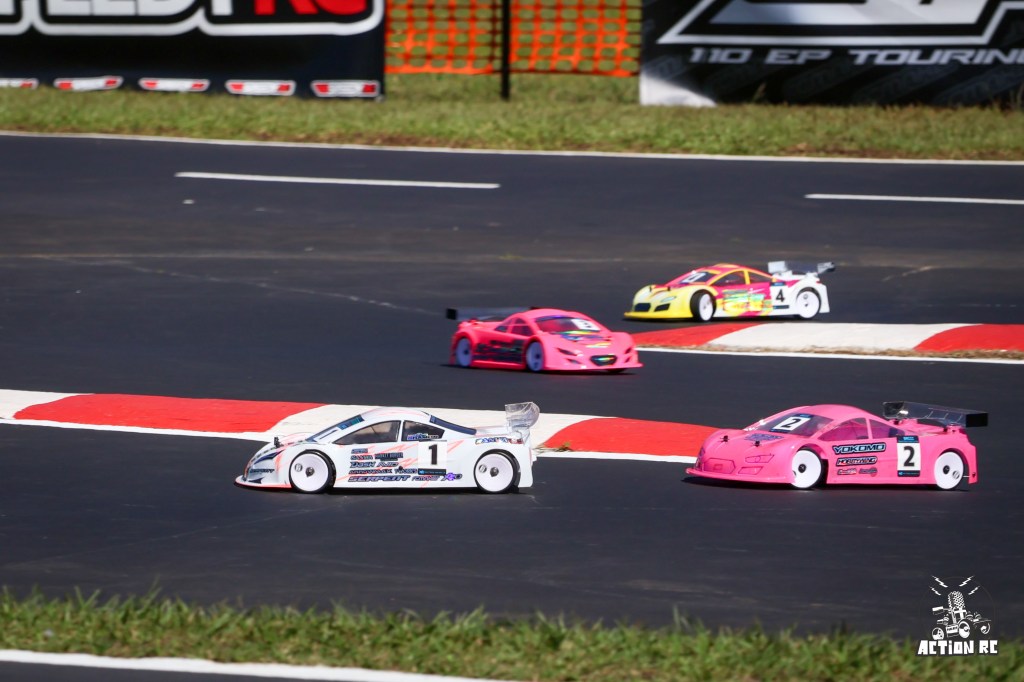
First heat, the TC5 was a fair way off the fast guys (Anthony Atack, Scott Parkinson and Peter Dooley), as the car wanted to turn inside itself throughout the run – due to rear end breaking traction (even with dual rate down to 50%). I also kept in mind to be cautious with the car as I had no spares if anything went wrong. After the run, I made my normal changes (adjust shocks – angle and springs), next heat was only marginally better. So in the final run of the day I made “wholesale” changes (a massive 5 in total: front and rear roll centre raised, front and rear shock springs changed to heavy rate, changed the rear diff height to med-high, reduced the amount of front droop and finally adding more rear toe in) and it was much better, but still way off the pace and after nearly missing the qualifier and taking nearly 2 whole hours of wrenching time!
Thoughts and Visions:
After arriving home from racing, I decided not to work on the car and to think about what I needed to do in order to get the car to a “competitive” level. I reassessed the setups Rick Howart sent me and also what I had learnt for the first day. I then wrote down the changes I thought would make a difference (balancing the car out by reducing how “hard” the front end was working by changing roll centre heights, diff heights, inboard front toe, actual toe, and also changing the rear shock mounting position) and work on the car at the track in morning. It took nearly 2 hours again of wrenching and almost missed the last qualifier of the meet, but I got it done. The changes were in the right direction, as my times had improved dramatically. The car was still not quite right (still lacked “stable” rear end grip and had too much steering – not 100% balanced), so I decided to stiffen up the rear roll bar and change the bump steer settings (from lots of bump steer to almost none) in preparation for the finals.
Finals Time!
First final and the car was the best it had been for the meet so far. I was still off the fast guys pace, so I decided to change droop settings (reduce overall droop front and rear) and this was again a change for the better. Lap times dropped slightly in the second final. For the last final, I was still chasing more from the car and decided to give the car some chassis rake; this made a big difference to the handling of the car as it was getting close to the lap times of the fast guys. I was in second place after some of the frontrunners came together and was holding that quite comfortably when I made a massive error off the back straight and needed marshalling. This allowed for most of the field to catch upand in the end I eventually worked my way back up into third position and held this until the end of the race.
I was very happy where the car ended up in the third final (both position and how the car felt/responded). There is still room for lots of improvement and I strongly feel that the TC5 will be an extremely competitive car (just like most top level TC kits). Especially when the ITF chassis/top deck and Spool become available (I think a MUST for rubber tire asphalt racing!). I can’t wait for the parts to arrive – to continue my testing and progress with the TC5!
Pros:
- + Metric screws and bearings
- + Belt drive
- + Very Adjustable
- + Comes with all roll centre blocks, arm mount shims, spacers and roll bars
- + Well thought out and high quality finishing on all parts
- + Lots of room to mount electronics
- + Nice ‘little features’ (ie. chassis balancing holes – main chassis and shock towers)
Cons:
- – not ready to run on asphalt with ‘kit setup’
I would like to thank Trackside RC and Ace Hobbies for supplying the TC5. I look forward to further developing the car and hopefully more successes. I will keep you posted.
Thanks,
Leonard.


 Action RC
Leave a reply to heavy Cancel reply