
 Schumacher have reacted quickly as the racing world moves exclusively to LiPo batteries and released an update to the highly successful Mi4 tourer.
Labeled the Mi4-LP, the car now includes a LiPo specific chassis, and design changes to make the most of revised weight distribution with the lighter battery technology.
Other changes over the Mi4 include some of the option parts that were regularly used by our team drivers – including shorter carbon fibre impregnated suspension arms, more flexible front castor blocks, and a revised layshaft to provide more consistent flex at the rear of the chassis. Different material for pulleys and spur gear complete the changes.
For those new to the Mi4 family of race chassis, there are a stack of other features worth noting. We’ll try and point them out as we go through the build and test process.
The Mi4-LP is available in both Pro and Race versions. We’ve built the full-house Pro version, but the Race version is definitely worth a look if you’re on a budget. S1 (fibreglass-like) chassis material, simpler shocks and no sway bars are the major differences. It’s a great race car at a stunning price point.
We built up a new Mi4-LP and took it to the track to see just what it was capable of. Read on for more…
Gear Used
We built the LP (as we’ll call it) in time to run in the 2010 Tasmanian Championships. With the modified class running short of the entries as we headed off for our test run, we equipped the LP to run in superstock. For me that means Speed Passion’s new V3.0 10.5 turn motor, the Racing Lines test LRP SPX Stockspec ESC and IP5000/40c LiPo batteries. My usual Futaba S9402 servo (really must replace it one of these days, it’s 6 years old now!) and Spectrum DX3s radio completed the electronics package. Tyres for our test are Schumacher pre-mounts (Sorex 36r or 32r tyres, C Medium inserts on Schuie Revlite rims) and the de-facto standard bodyshell, the Protoform Mazda Speed 6.
Build
Schumacher have come a long, long way over the past ten years in terms of material quality, parts fit and finish and outright design improvements. Always innovative, now the clever design features are matched by a build quality and build experience that are second to none.
The basis of the LP is a twin-deck carbon fibre chassis – both 2.0mm thick in kit form. It is incredibly narrow, with battery, motor and eletronics overhanging the chassis once everything is installed. The reduced width should limit the chassis grounding through corners.
Beautifully machined transmission housings front, rear and centre locate the drivetrain, and form the main mounting points for suspension all round. Minimal mounting points and a seperate centre transmission mount minimise tweak and make for consistent flex throughout the chassis. With flex characteristics one of the key design features in modern TC’s, the Schumacher design team have got this spot on.
Construction of the LP starts with the transmission. The LP is equipped with a ball diff in the rear, spool up front and twin belt drive. Early on in the construction an important decision is to be made. The drivetrain can be installed in one of two ways – allowing the motor and radio gear to be mounted more centrally and thus fundamentally changing the side-to-side weight balance of the car. With LiPo batteries so light the option to move the gear closer to the centre is a potentially important facility. I built my car in the standard configuration to start with.The new layshaft mounts from one side only, floating free on the other side in the manner of the Mi3. This small change lets the chassis flex more through this section – and that extra flex can be controlled by a set of optional link plates of varying widths.
The LP continues Schumacher’s commitment to ease of access to critical components – with both diff and spool needing just two screws to have them out, and the layshaft one. It might not seem like that big a deal, but when you need to get at those components on a busy race day, every second counts.
The rear diff is unchanged apart from the pulley material. Schumacher continue to have the best thrust race in the business and the diff has proven reliable. One change I made as I built the kit was to replace the standard ceramic diff balls with carbide. The longer life is particularly important in modified. Today’s horsepower in the modified class is unbelievably hard on diffs, and the longer life for carbide balls matters a lot. In spec classes, the standard diff balls will be butter smooth and utterly reliable. Don’t be tempted to use other brand diff lube – Schumacher’s silicon lube finds its way into many other manufacturer’s cars – stick with it.
The spool too remains unchanged from the Mi4, chunky outdrives that in our experience have been flawless. A small moulded blade clips over the drive-shaft to run in the spool outdrive and save either from wear and tear. These blades should be considered consumable items and replaced regularly. Look for small white stress marks on the blade and as soon as they appear, bin them. In modified that means as often as every 4-6 runs on the front (rears will last much longer). Don’t stress though, they’re cheap!
Diff and spool are both mounted in eccentric cams, allowing for fine adjustment to belt tension, and adjustment of diff height to change the handling characteristics of the car. The stock belts are great for mod and fine in both stock and superstock, but Schuie do offer a more flexible belt perfect for the spec classes (just don’t run it in modified).
Suspension both front and rear bolts to the transmission housings. Moulded suspension mounts provide a fixed roll centre – extensive testing from the team finding the best positions for the majority of tracks. Fine adjustments to roll centre can be made at the top link, or alloy suspension mounts available as an option provide endless adjustments. On the Mi4 we’ve found no reason to change from the standard mounts.
Suspension design is otherwise fairly conventional, the LP including shorter and stiffer arms than the Mi4 – the result an improvement in corner speed and consistency. 4 degree castor blocks up front in a flexible material that should prove strong and robust. Front and rear anti-roll bars are included as standard, with optional bar kits available if you want to try something different.
Schumacher’s shocks are carried over unchanged from the Mi4 – and why would they change what is a fantastic design. The shocks go together easily, and are simple to build with a high degree of consistency from shock to shock. As with all shocks you should consider replacing O-rings regularly to ensure performance stays high.
The LP kit includes blue front and white rear springs (14 lbs and 12 lbs respectively). I think that might be a touch soft for my liking, but will run the initial test with the kit springs and see how it pans out.
Centre-pivot steering, with easy to adjust ackerman just about completes the mechanical package.
Body mounts are easily adjustable for height and mount the body securely, while a nice foam bumper keeps things safe and sound up front.
I opted to add a carbon fibre LiPo retaining strap to the standard chassis package. The kit is designed around the use of tape to retain the battery, but I’m old and lazy, and like the simplicity of the strap. Adjustment of the retaining posts with shims allows you the option of a tight fight, or preferably a little play to ensure the battery fitment doesn’t interfere in the flex of the chassis. A retaining strip protects the pack from damage in a side impact.
Electronics install is pretty straightforward. Schumacher supply three different servo arms, and a multi-piece servo saver. Modern metal geared servos are pretty robust, so I went with a solid arm. If you want to run a servo saver, you can try the kit item, or probably better yet squeeze in a mid-sized Kimborough unit.
I found sufficient space to mount everything else on the chassis – though as I noted earlier the electronics do slightly overhang the super narrow chassis.
Motor mounting will be something different if you’re coming from another brand car. The motor slips into a clamp style mount, with the whole mount then sliding back and forward for gear mesh setting. In practice its easy to use and perfectly reliable in our experience. Once again, the mount design minimises impact on the flex of the chassis (you get the impression Schumacher think flex matters!).
All built, and race ready, my Mi4-LP weighs in a touch under 1400grams. That’s with no lightweight option parts, and pretty heavy electronics – so it should be relatively easy to get down to a much lighter weight. In Australia we seem to have settled on 1425 including timing equipment, so the Mi4 LP comes in just about where you’d want it – with a few grams to play with for balancing.
Drive-Time
The build done, there was only one task remaining. Drive time.
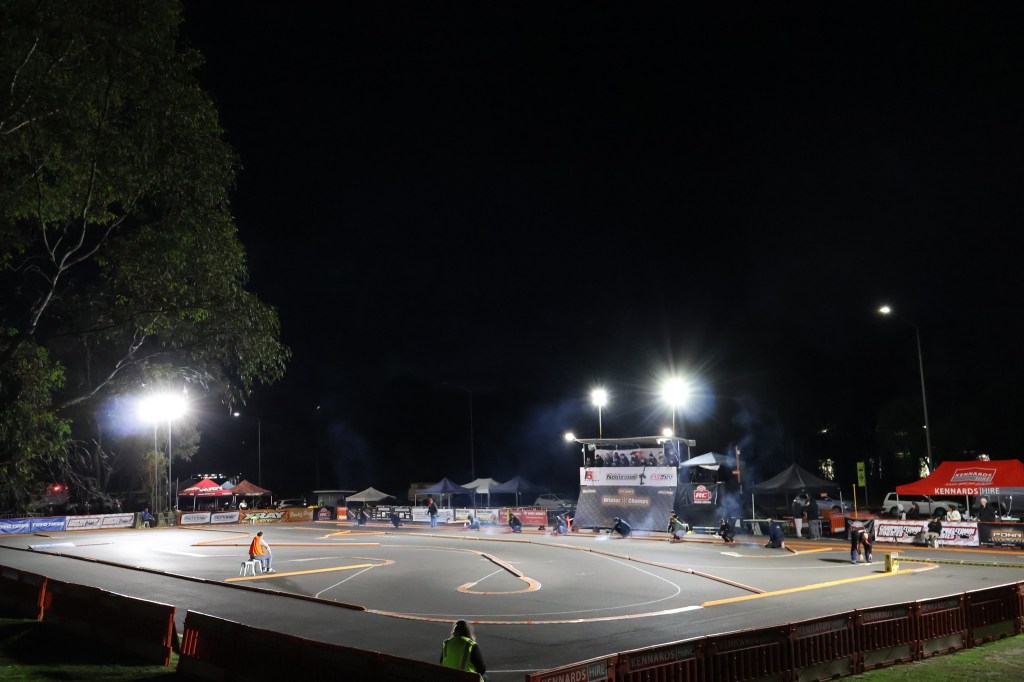
We headed down to Hobart for a club event at the excellent Goodwood circuit. The track is a medium-low grip surface, and features a great combination of high and low speed corners. One high speed right-left combination puts a particular emphasis on the ability of the car to change directions quickly and at speed. All in all a good test venue, and one I’ve come to know reasonably well having run there three times now.
As I noted, we started in the superstock class, with modified class racers thin on the ground in Tasmania. Weather on our test day started cool, but finished hot (true!), gusty windy blew all day and the track stayed dusty and slick.
Right out of the box, the LP is very race-able. It turns in well, holds good corner speed, and puts power down nicely. Its immediately apparent that this is a very well sorted chassis. That of course comes as no surprise, with the LP carrying most of the option parts used by the Schumacher Team on the Mi4 over the last year.
After a quick shakedown run to make sure everything was built properly, we set ourselves for race day.
The first full run was nice and solid. Track conditions were cool, and generating a reasonable level of grip despite a liberal coating of dust. With air temperature an overcast 18 or so, I opted for Sorex 32 tyres. The car did step out just a little on a number of occasions, and I was a little ginger through the fast right-left combo. That said, others struggled more in the conditions, and I did manage to lower the one-lap track record (to 14.8), and in the process went faster that my previous visit to this track in this class.
For the second qualifier, I reduced front toe-out a little, and switched to HPI Silver springs all round – a favoured setup for the Mi4. The car was definitely better, a little safer through the change of direction, but with very little loss of that sharp steering response. On the clock it didn’t show so much, with fastest lap just a tenth quicker than run one at 14.7.
The Hobart club run a nice 2-qualifier, 3-A final format, so we were into the finals, and off the front row of the grid.
A1 I added some FXII traction compound, still sticking with the Sorex 32’s, though by now track temps were climbing rapidly. As track temps climb in Hobart, lap times drop off markedly – in this run I was at 15.0 for my fastest. The track was greasy, tyre goop not a good choice, and I paid the penalty. After an ugly start I trailed for a few laps, but working through the field to lead and go on to a comfortable win.
For A2 it was time to switch to Sorex 36, with track surface temps now hovering at 45 degrees. Not wanting to confuse myself, i left the chassis as it had been for A1. The car was excellent, tyres handling the conditions better, and despite grip levels in the track continuing to drop, my lap times were back – fastest at 14.8 in this run. Another ugly start, but this time popped up in second, took the lead on lap 3 and finished off with another good win. Overall race time was very similar to Q1 – definitely an improvement given the decreasing grip levels.
For A3, it was still hot, still greasy. I raised the rear inner camber link plate by 1mm, with the hope of promoting a little more rear grip via a lowered roll centre. The change worked and the car was quite locked in on this run, turning my fastest lap (14.7) and run of the day in a winning time. Even with a body-tuck requiring marshall’s assistance on lap one, this run was still a second faster than I had managed in the cool of the morning.
Small changes really paid off with the Mi4-LP. The total of changes for the day including different springs, reduced front toe-out and raised rear camber link. In each case these changes were directed at track conditions, and in each case the car responded just as I hoped it would.
A clean sweep is always a nice way to start with a new car. I saw enough from the LP today to be sure that it’s a very fast race car, and a small, but visible step forward from the original Mi4. The new chassis layout worked well, and all the other new parts were faultless for me today.
We’ll be back at the Hobart track in two weeks for the 2010 Tasmanian Championships. I’m hopeful of being able to report back on a State Championship win for the Mi4-LP. Certainly the car is capable.
Final race setup from today is here: mi4lp_scott_hobart_feb_2010_superstock (pdf file)

 Action RC
Leave a comment