Since my first build report on the TC5, I’ve made lots of progress with setup, customising the car, testing 5 cells and more. Read on!
Practice Day – Brendale:
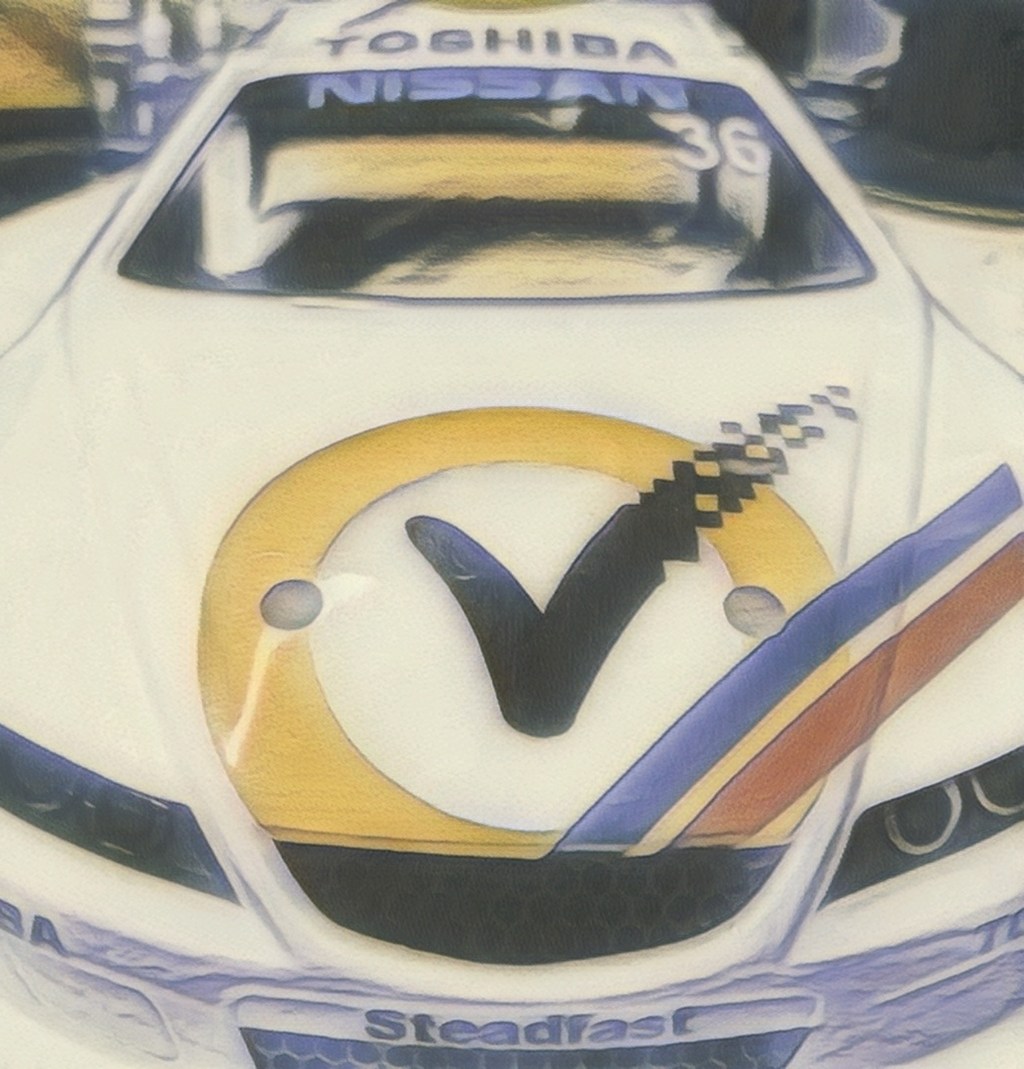
Since the first report and build guide about a month ago, there has been some developments and progress made with the TC5. Initially when I got back to ‘home turf’ (Brendale – England Park Raceway), I chose not to change the setup I had from the last run in Tamworth. And as expected, the car handled very similarly – lots of ‘off centre steering’ and the car tended to steer from the rear end (Not the ‘ideal’ way to get around in a touring car – in my personal opinion). I ended up changing tires, lowering roll centre frt and rr, more droop and thicker rear sway bar in that order. This made the TC5 quite easy to drive the car seemed to carry a good amount of corner speed by the end of the practice day. I also messed around with bodies – Mazda Speed6, Mazda 6 and Ride Stratus.
The difference between the bodies were vast. Basically the bodies did this:
Mazda Speed6 – made the car very aggressive and slightly ‘twitchy/nervous’ to drive (not very stable)
Mazda 6 – was great! (had good steering and rear downforce = very stable to drive)
Ride Stratus – lacked some steering and rear end grip (I think this would be a good body to run with either foams or high grip tracks/or in 19t/stock)
19t Night – How high do I have to go?
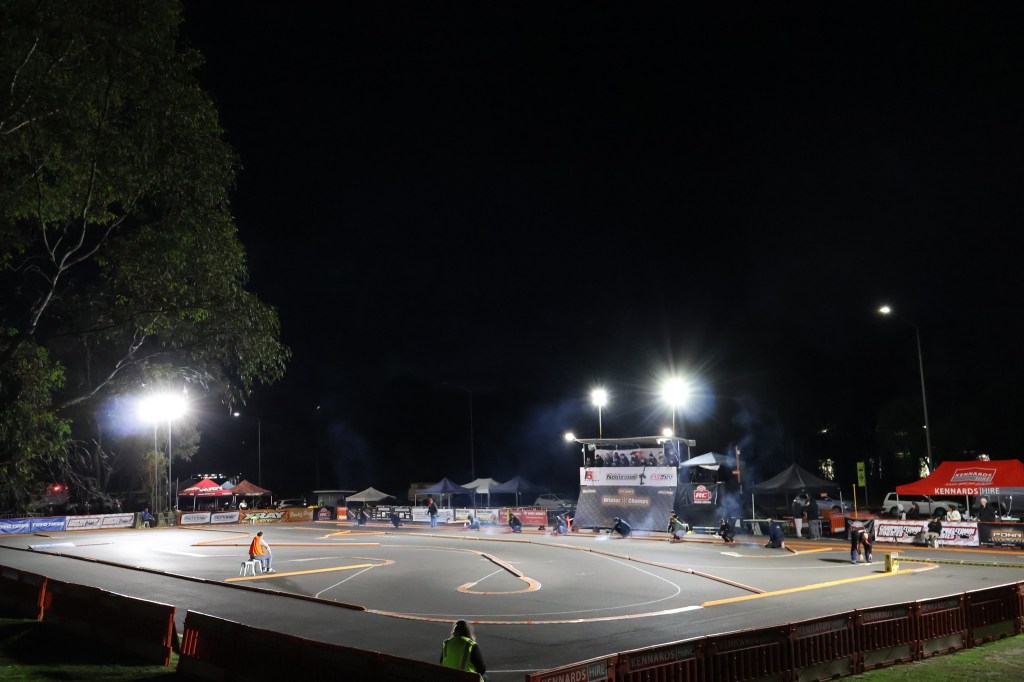
Next run for the car was a Friday night at Brendale (19t). I went there with the setup I had worked on earlier in the week. I was testing the replacement/new brushless motor from Novak (10.5t) which is meant to be similar in performance to a brushed 19t motor. The 10.5t motor has a sintered rotor as standard and has a distinctive blue ring around the end of the motor (makes it easy for teching). I went out for the first run not really knowing what gear ratio to use as I do not normally run 19t class. I started with 5.50FDR (Final Drive Ratio)and the car was slower than a rebuildable stock motor! I was about 2 secs per lap slower than the slowest person. Next run, I geared up to 5.00FDR and it was a lot better, but still slow compared with the brushed and brushless (SS4300) 19t racers. In the third run, I geared up again, this time to 4.70FDR and it was now approaching the speeds of the other racers. For the final run of the night, I geared up yet again, to 4.50FDR!!! I was beginning to run out of spurs and pinions. Anyway, the car was absolutely flying now!!! Overall, I did not spend anytime on car/chassis setup, rather on changing spurs/pinions to get the right gear ratio for the 10.5t motor. So if this motor gets approved by the Interclub Committee, for use in the last few rounds, then my advice is to gear up!!!
After Friday night, I received some of the much anticipated parts for the TC5:
ITF Chassis
ITF Top Deck
0.5 and 1.0 degree rear hubs
ITF = more lateral flex (thinner chassis and more flexible to aid in traction)
Needs and Wants
I just wanted to stress that the ITF chassis is an ‘option’ and not required for the TC5 to work on asphalt. I have tried varying combinations of the std chassis and the ITF chassis and have found with some minor adjustments, the std chassis works just fine on asphalt with rubber tires. The only items you will definitely need are:
Gold/Blue/Silver AE springs
Piston kit
30-40 wt shock oil
Sunny Coast – 5 cell day:
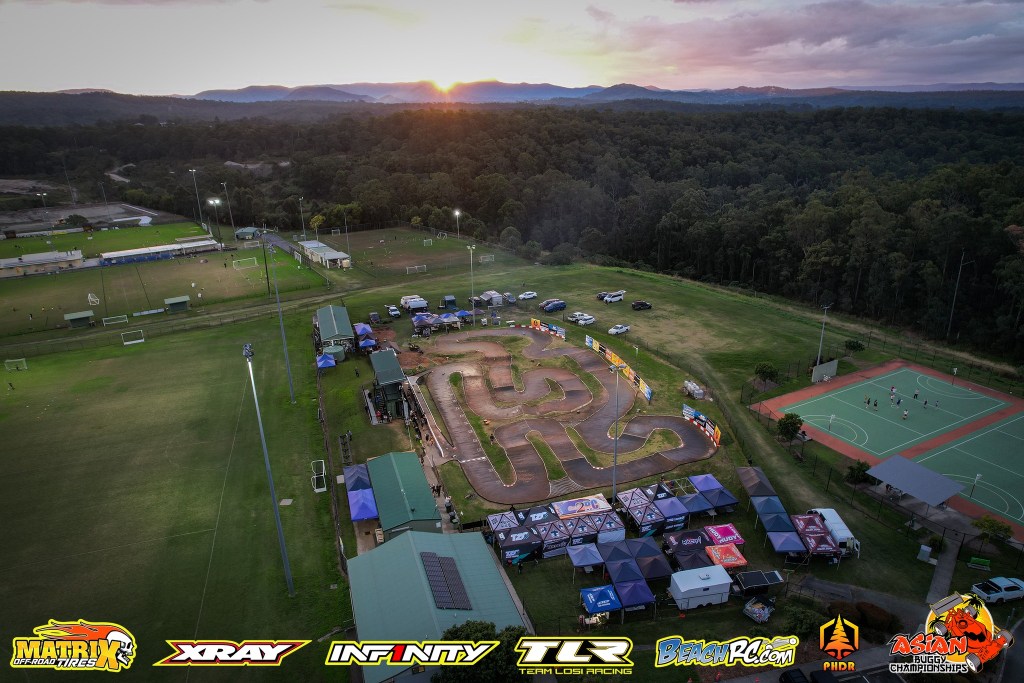
This is a track that I love to race on. The track is situated in Landsborough, in the Sunshine Coast Hinterland and is about an hours drive from Brisbane. The club is relatively ‘new’ and the foundations for a magnificent race facility are not too far away. The atmosphere and enthusiasm by the local racers, club officials and volunteers is astounding and it is the only place I have seen in recent times that fosters and supports such a large number of junior racers (both boys and girls). I personally feel strongly about ‘juniors’ in RC as they are the future of our sport/hobby – “True Grassroots Racing”. Enough said about this. I’ll save it for another report…..
Onto racing and testing. I made the decision to test 5 cell mod touring car racing for a couple of reasons:
• To see what the performance differences were (car speed and handling) against 6 cell cars
• If there were any issues (runtimes, personal transponders)
• Wear on tires and drive train
• Temperatures
With the European countries and more recently the RROC in the USA (Reedy Race of Champions), all converting to 5 cell racing, and seeing some footage from the races (BRCA, RROC, Scottish Championships), I wanted to see for myself what the differences were.
To start with, obviously all my 6-cell packs were converted over (luckily for me I had five 6-cell packs and this allowed me to make up six 5-cell packs). I decided to mount the battery pack all the way forward and then proceeded to balance the car laterally.
I also decided to go away from my ‘developing setup’ and to try Craig Drescher’s setup from round 1 of the BRCA championship. The most notable changes from my setup was:
• Shock oil (lighter)
• Piston (greater speed and less dampening)
• Diff height (mid low frt and rr)
• Lower rr roll centre
• ITF chassis/topdeck
I have been trying different shock oil since Tamworth and have also been running the car without sway bars – the reason for this was to make the car more consistent to drive.
In race one, the car felt good to drive; although it lacked some corner speed/aggressiveness, which I presume was due to the slight ‘on power push’. The most surprising aspect of the race was the actual car speed I had against the 6 cell cars. There was only a slight noticeable difference in speed, but I was still chasing the ‘right’ FDR.
For the next run, I chose to reduce the camber from 2.0 degree to 1.0degree as the tires were ‘coned’ a little (wore the inside contact patch and the outside edge of the tire was ‘like new’), and altered the FDR by increasing the pinion size up 1 tooth. These 2 changes made a 0.4sec per lap difference. And my consistency and avg. lap also improved.
In the third run, I changed nothing on the car as I felt it was quite good, but I wanted to test something, so I opted for a profile change on the LRP TC spec esc. I went to a slightly ‘softer’ profile to what I was previously running. During this run, the car was ‘pushing‘ severely everywhere (both on and off power) and ‘felt slow’ around the track – not straight-line speed. I came back and checked the lap times to see that everyone including myself went faster! I was 0.1 sec per lap faster! Obviously as the track and ambient temps heated up, so does the levels of grip.
After sitting in the pits, thinking about what the best course of action would be – to overcome the understeering issue, I decided to try ‘anti-dive’. I have always liked this as it helps keep the car from unloading the rear weight to the front and keeps the front of the chassis/car flat, it also reduces the ‘actual’ caster slightly (depends on how much anti-dive you use – 1.0 degree of anti-dive = if using 4 degree caster blocks will give you a total of 3 degrees of caster which makes the car initiate a turn quicker and gives the car more on-power steering).
In the final run, I noticed that my tires (from last year’s QLD titles – Sorex 36R/xenon black insert/Speedmind rim) were rather worn on the left hand side and decided to swap them around (left to right). This was a mistake, as I should have replaced the tires with newer ones. The car was like a ‘drift’ car from the start. I was not able to put any power down (even in a straight line!). Hence to say, my final race was a disaster! Not to worry – lesson learnt.
Anyway, not wanting to waste an opportunity, I really wanted to see if the car was better with the anti-dive. So I cleaned up the car and charged another battery and waited for racing to finish for the other classes. I changed nothing but tires (keeping them the same – just newer ones) and went back out. What a difference it made!!! The car was totally different – in a great way! The anti-dive as I predicted gave me the steering I wanted and needed. The on and off power push was gone and the car drove extremely well around the track. Hindsight is such a wonderful thing! Oh well, at least I have a great starting point for my next outing up at the Sunny Coast.
Weight off my mind:
When I got home, I weighed the car and it came in at 1430 grams race ready (with 43 grams of lead weight – to balance the battery side). I have since reworked the electrics on the car as I wanted to reduce the amount of weight the car carried. The reason for this is because I did not run my LRP motor heat sink (which weighs approx. 40 grams). So if and when I need to run the motor heat sink, I wanted to have the car underweight so that I can balance the extra weight of the heat sink and fan on the electrics side to that of the battery side without carry a lot of extra ‘ballast weight’.
I have now turned the esc 90 clockwise so that the buttons on the esc face the motor and this has allowed me to run the esc closer to the centreline of the car. By doing this, it has reduced the weight needed to balance the battery side of the car by nearly 30 grams!!! I have yet to reweigh the car race ready, but I will you all posted on the progress.
I have also posted my latest setup sheet from the Sunny Coast on the setup’s section.


Stories from the world of RC car racing
One response to “TC5 Continuing Progress…..”
-
Great write up Leonard, can’t wait til I get mine now, see you at the coast next…
LikeLike

Action RC
Welcome to Action RC, a home of stories from the world of RC car racing.
Listen to the Action RC Podcast, read race reports and previews, the latest in product reviews or our regular opinion and reflection pieces.
Contact us for content requests or more information.
 Action RC
Leave a comment